Commission Continues Hearing On Wetlands Rule
The Old Saybrook Planning Commission found that an AI review showed regional housing data left 18 of 23 local questions unaddressed.
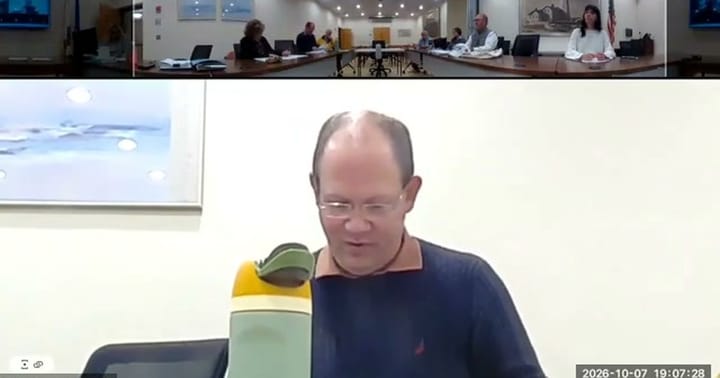
Planning and Zoning · Meeting of October 7, 2026
OLD SAYBROOK — The Old Saybrook Planning Commission found that an AI review showed regional housing data left 18 of 23 local questions unaddressed. At the October 7 meeting, a staff member said running RiverCOG's September 23 response through Claude found "none of the 23 questions and the feedback is fully answered. Five are partially answered and 18 are not addressed at all." Commissioners flagged specific discrepancies, including a mobile-home share rising to 1.5 percent despite no known permits, and a housing-unit count that doesn't reflect the 186-unit Saybrook Station development.
The nine-member commission split a 32-page RiverCOG data report into page assignments to check before RiverCOG's October 27 regional meeting. Separately, the commission continued a public hearing on subdivision open-space wetlands rules to October 21 after discussing capping wetlands at 2.5 percent of the required 10 percent open-space dedication.
In the full story:
- Who Was There
- Organizations And Documents Referenced
- The complete report — 2,261 words
Source: the Planning and Zoning meeting of October 7, 2026, reported from the official video recording and transcript.
The Full Article
Call to Order, Roll Call and Minutes
The Old Saybrook Planning Commission convened its regular meeting at 7:06 p.m. on October 7. Chairman Michael Bender called the roll: Nick Prevost, Tina Rupp, Erin Tornayel, Dennis Tulamary, Jerry Lewis and Hallie Dupronos-Stradwell answered present; Doug McFadden was reported absent. Bender noted that at a prior meeting the commission had appointed alternates to fill in for absent regular members, with Dennis Tulamary seated for Doug McFadden and Hallie Dupronos-Stradwell seated for Tina Rupp; Rupp subsequently joined the meeting by remote connection after the public hearing had already opened, and the chair clarified for her that she would be seated as a voting member going forward but had not been counted during the hearing's opening vote. The commission approved its August 19 minutes on a vote of four in favor and one abstention; no corrections were raised. There was no new correspondence reported.
Public Hearing: Subdivision Open Space and Wetlands Regulations
Background and stakes: The commission took up a petition, continued from prior workshop sessions in June, to amend Subdivision Regulations sections 5.8.1, 2.8.1 and 5.9 governing the 10 percent open-space dedication required of new subdivisions. A staff member identified in discussion as Chris told the commission the change was prompted by a recent subdivision application in which an entire wetland parcel was offered as the dedicated open space, leaving the town with no usable land and raising the concern that wetlands, which are separately protected and sometimes subject to fill permits, should not substitute entirely for a meaningful open-space set-aside.
The question before the body: Whether to adopt, as advertised, a regulation barring wetlands, tidal wetlands and watercourses from counting at all toward the mandatory 10 percent open-space dedication, or to amend that language before acting.
Substantive content: Staff reported that referrals went out in September to the building official, fire marshal, police chief and fire chief under standard practice, with no objections received. The town engineer raised no objection and the town attorney reviewed the draft without concern. The Conservation Commission discussed the amendment September 8 and voiced no concerns, and the health department had no objection. The Connecticut River Gateway Commission replied September 28 and, according to staff, did not identify an inconsistency with the Gateway Conservation Zone. The state Department of Energy and Environmental Protection had been sent a referral but had not yet responded within its 35-day window; staff said they did not expect an objection to a regulation that increases open space.
The deliberation: Once the hearing opened, commissioners debated whether the advertised, full exclusion of wetlands was the right approach or whether a partial allowance made more sense. One member proposed capping the amount of wetland acreage that could count toward the 10 percent dedication at 2.5 percent of the total required open space, rather than excluding wetlands outright, framing it as "25 percent of the 10 percent." Another member pushed back on relaxing the advertised language before the commission had tested the stricter version, arguing: "I feel like the natural pressure on this regulation is going to be from owners to have less, right? And so I feel like, in a way, if we start with this kind of solid platform, we're more likely to get more of the open space that we're looking for." A third member countered using a past subdivision, the Ture property, as an example, arguing that a hard exclusion could end up pushing developers to offer more wetland-heavy open space while giving up less usable land, saying "at what gain" the stricter rule would produce if it simply raised housing costs without producing usable recreational space. The exchange continued over whether the open space is genuinely usable, whether a private subdivision's open space serves any public recreational purpose, and whether a flat percentage cap would discourage developers from voluntarily dedicating additional wetland acreage for permanent protection. The group ultimately converged on draft language allowing up to 2.5 percent of the minimum 10 percent dedication to consist of wetlands, tidal wetlands and watercourses, while permitting a developer to dedicate wetland acreage beyond that 2.5 percent voluntarily, without that excess counting toward satisfying the minimum requirement, once the minimum had otherwise been met with developable land.
Procedural steps and outcome: No one from the public spoke; staff noted the unseated Planning Commission alternates and Housing Task Force members present counted as public for hearing purposes, and no hands were raised online or in the room. With the amendment language still being finalized, the commission voted unanimously to continue the public hearing to its next regularly scheduled meeting on October 21, 2026, rather than close it or vote that night.
Implications and what is next: The final wording of the wetlands cap will determine how much of a subdivision's open-space obligation developers can satisfy with wetland acreage going forward, directly affecting how much usable, buildable or recreational land future subdivisions must set aside. The amendment returns for possible action October 21.
Regional Housing Needs Assessment Workshop
Background and stakes: Old Saybrook is participating in a regional housing plan process coordinated by RiverCOG rather than drafting its own standalone housing plan. At an August 19 workshop, the commission reviewed municipal existing-conditions data and a housing needs assessment methodology and compiled roughly two pages of questions, primarily about demographics, vacancy classifications and seasonal housing, to send back to RiverCOG.
The question before the body: Whether RiverCOG's September 23 response packet adequately answered the commission's August questions, and if not, how to proceed.
Substantive content: Staff told the commission the September 23 packet was a compilation of answers intended to serve every municipality in the region, not Old Saybrook specifically, including three methods for calculating vacancy by tenure, population-projection methodology and missing-household calculations. Staff said they reviewed it personally and then, borrowing an approach used by fellow commission member Bob Friedman, ran the questions and the RiverCOG response through the AI tool Claude. "Claude came back and said none of the 23 questions and the feedback is fully answered. Five are partially answered and 18 are not addressed at all," staff reported, prompting a member to ask directly which five were answered.
Commissioners walked through specific local discrepancies they had flagged in August. Page 13 of the municipal data packet showed an unexplained red-flagged line for housing unit types: an unidentified baseline in 2014 rising to 0.7 percent mobile homes in 2019 and to 1.5 percent in 2024. Members said, to their knowledge, the town has not issued any mobile home permits in that period. Separately, commissioners said the data's total housing-unit trend line does not show a one-year increase approaching 186 units, the number built under the Saybrook Station Incentive Housing Zone, approved in 2015 and first occupied in 2017. They also flagged a measure of "severe overcrowding" households that rose from 25 to 97 before dropping to zero in 2024, with no explanation of methodology.
The deliberation: A member summarized the core disagreement: "Most of our questions were about the Saybrook's number... how do we match Old Saybrook to the region so that we can work with this." Another commissioner questioned whether the level of granular, town-specific detail the commission wanted was simply outside RiverCOG's intended scope. One exchange turned on whether the commission could evaluate the regional allocation formula at all if it did not trust the underlying municipal data: "If we don't think that the underlying data and like the trends are solid, then can we assess the regional formula or look at the formula in the APSRA Act?" Staff and members agreed that because the project is organized in phases, with phase one baseline data due by June 2026, phase two covering the housing-need formula, and phase three addressing municipal allocation, the commission is effectively still contesting phase one inputs while the schedule has already moved into phase two work.
Procedural steps and outcome: No vote was taken. Commissioners agreed to divide roughly 32 pages of the RiverCOG existing-conditions report among the panel's nine members, assigning blocks of pages: Doug McFadden, pages 1-3; Nick Prevost, 4-6; Hallie Dupronos-Stradwell, 7-9; Jerry Lewis, 10-12; Erin Tornayel, 13-15; Dennis Tulamary, 16-19; Michael Bender, 20-23; Tina Rupp, 24-27; and Bob Friedman, 28-30. Each member is to map specific questions to specific pages and data points rather than resubmitting general questions, and email findings to staff before the October 21 meeting so comments can be compiled and sent to RiverCOG ahead of its October 27 regional meeting.
Implications and what is next: The commission's homework assignment is intended to produce a page-by-page accuracy check that will shape what, if anything, Old Saybrook asks RiverCOG to correct before the regional housing-need number, and the town's eventual allocation of it, is finalized.
Mixed-Use Housing Study and Grant-Funded Projects
Staff reported the town's mixed-use housing study is nearing completion but has been extended after two additional parcels, including the Beard Lumber property, came into the project's scope; a letter to the Connecticut Department of Housing secured an additional $25,000 for septic and soils analysis and a parking-needs assessment, pushing a hoped-for February completion likely into April. On the Chalker-Chapman grant project, staff said a public outreach session was held and attendees requested a second session for additional input, which staff said the town will accommodate; that project also faces an extension but needs to wrap up near March to meet grant-reporting deadlines ahead of the next funding round. Staff said work on public-improvement regulations, covering fire protection access and engineering/grading standards, has stalled amid competing demands on engineering and public works staff.
Proposed Data Center Zoning Regulation
Staff outlined a draft approach, prompted by a question raised at a recent regional planning meeting, that would prohibit stand-alone commercial data centers in town but permit "accessory data centers" of up to 1,000 square feet tied to a permitted use, such as a town facility or office building. Staff said drafting avoided detailed cooling-technology provisions on advice that such specifics belonged in site-plan review rather than the zoning text, and noted that prohibiting free-standing facilities would still allow a property owner needing more space to petition to amend the regulation, whereas a use that is outright prohibited cannot seek a variance.
Saybrook Point RFP and Shoreline Resiliency
Staff said the committee reviewing the Saybrook Point request for proposals, which included commission member Nick Prevost, has interviewed six finalists and collected member scores, but the town has not yet closed on a selection; additional finalist interviews remain possible if no clear leader emerges. On shoreline resiliency, staff said a joint selection committee with the town of Westbrook, potentially including beach association members, is being organized to evaluate feasible projects once identified, with a current grant needing to close out by March.
Upcoming Meetings and Adjournment
Staff said the October 21 meeting will follow a Zoning Board of Appeals executive session in the same conference room, which may run long. A planned housing-workshop presentation has been pushed back further given the pace of regional work. The previously postponed Dark Sky presentation has been rescheduled for November 30 at 6 p.m. in the same conference room. The commission voted unanimously to adjourn.
Michael Bender, Chairman, present Nick Prevost, member, present Tina Rupp, member, present (joined after the public hearing opened) Erin Tornayel, member, present Dennis Tulamary, member, present, seated as alternate for Doug McFadden Jerry Lewis, member, present Hallie Dupronos-Stradwell, member, present, seated as alternate for Tina Rupp Bob Friedman, member, referenced as assigned homework pages but not confirmed present by name at roll call Doug McFadden, member, absent Chris, staff member presenting subdivision and regional housing items, title not stated in available sources Janice, staff referenced once as an email recipient for member comments, role not stated in available sources Carl, referenced once in connection with a letter to the Connecticut Department of Housing, role not stated in available sources No members of the public spoke during the subdivision public hearing; staff reported no one raised a hand online or in the room.
RiverCOG (regional council of governments, rendered in the transcript as "River Cog(s)") — provided the September 23 regional housing data packet discussed in the housing workshop and hosts the October 27 regional meeting the commission is preparing comments for. Connecticut River Gateway Commission — responded September 28 to the subdivision regulation referral. Old Saybrook Conservation Commission — discussed and supported the subdivision amendment September 8. Old Saybrook Health Department — raised no objection to the subdivision amendment. Connecticut Department of Energy and Environmental Protection (DEEP) — referral sent on the subdivision amendment, no response yet within the 35-day window. Connecticut Department of Housing — approved an additional $25,000 for the mixed-use housing study's septic, soils and parking analysis. Town of Westbrook / Westbrook Planning Commission — potential partner on a joint shoreline resiliency selection committee. Old Saybrook Zoning Board of Appeals — scheduled an executive session ahead of the commission's October 21 meeting. Old Saybrook Subdivision Regulations, sections 5.8.1, 2.8.1 and 5.9 — the regulation text under amendment in the public hearing. Regional Housing Needs Assessment / Determination of Housing Need Calculation, RiverCOG packet dated September 23 — the data document the commission is checking page-by-page. Public Act referenced in discussion as "PA 25-1" — cited by commissioners as a statutory requirement already addressed from a zoning perspective; exact title not independently confirmed in available sources. Claude (AI tool) — used by staff to cross-check RiverCOG's response against the commission's 23 questions.
Share this story
Know someone in Old who follows town government? Share Townbrief Old: they can sign up free.