EDC tables Main Street assessment, plans 2027 focus
Old Saybrook's Economic Development Commission heard that a $1.4 million Main Street property sale could displace Bongo Ron's restaurant.
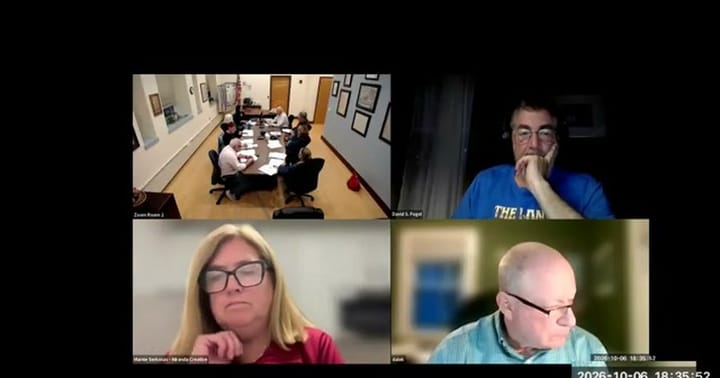
Other Committee 2026-10-06 Part 2 · Meeting of October 6, 2026
Old Saybrook's Economic Development Commission heard that a $1.4 million Main Street property sale could displace Bongo Ron's restaurant. A commission member reported the buyer, identified only as Colt, plans to open "a tavern" in the building that sold September 21; members said they have "no teeth" to intervene on a private lease decision. RiverCOG consultant Dale Croup, a 43-year economic development veteran, told the commission business retention "usually" consumes "70 and 90 percent" of a typical office's work and urged members to rank priorities ahead of 2027.
Marketing consultant Marnie reported 26-cent-per-click Google ad performance and an $8,000 cost for the commission's six-business video campaign. Commissioners approved September 1 minutes with one abstention and tabled a Connecticut Main Street Center assessment review.
In the full story:
- Who Was There
- Organizations And Documents Referenced
- The complete report — 2,660 words
Source: the Other Committee 2026-10-06 Part 2 meeting of October 6, 2026, reported from the official video recording and transcript.
Checked against the record: before publication this article was automatically compared with the meeting transcript. It was corrected where it differed.
The Full Article
Staff Report And Minutes
Jennifer, who serves as the commission's staff liaison and runs the town's economic development office out of Town Hall, opened the October 6 meeting with a condensed staff report, telling commissioners "I'm not going to belabor my report" since members had already received it by email. She highlighted a recap video covering the Mariner's Way and Saybrook Point projects that has drawn more than 12,000 views and nearly 500 interactions, and mentioned she would be speaking at the Chamber's Women in Business lunch at Saybrook Point that week. She also flagged a budgeting discrepancy: a line item connected to a recent bond issue that was finalized without her review. "I didn't notice till after it was already finalized," she said, adding that the Board of Finance had not raised objections and that the matter "is going to be rectified." No members of the public were present. Commissioners then approved the minutes of the September 1 meeting on a voice vote, with one member abstaining, apparently because that member had not attended the prior meeting.
Marketing Report: Third-Quarter Metrics
Marketing consultant Marnie presented the commission's July-through-September digital advertising performance. Google search ads remain the top-performing channel at 26 cents per click, with "restaurants in Old Saybrook" the single most searched term over the summer; the dining page was the most-visited page on the town's tourism website during that period. Social media following grew to more than 2,300 Facebook followers and roughly 1,800 on Instagram, both attributed to organic content rather than paid promotion. Visitor origin data showed Boston as the top regional market, followed by New York, with Old Saybrook residents themselves ranking third and New Haven fourth — a mix Marnie described as "a healthy mix of locals with people who are looking at Old Saybrook as a destination." July was the busiest month of the quarter, as expected for summer tourism, with traffic now shifting toward fall promotion and the town's Starlight Festival, expected in early November.
Commission member Dave Fogle asked two follow-up questions: whether the consultant's team could produce a year-over-year comparison of 2026 versus 2025 once fourth-quarter data is complete, and whether Old Saybrook's cost-per-click and engagement metrics could be benchmarked against similarly sized towns such as Madison or Essex.
"Do you think when we finish up Q4, could we get a comparison of 2026 versus 2025 on the key metrics so we could see what's going on?" Fogle asked. [00:14:06] — Dave Fogle, EDC member
Marnie agreed to prepare the year-over-year comparison for the commission's January meeting, but cautioned that cross-town benchmarking may be difficult because few towns the size of Old Saybrook invest in comparable paid marketing. Jennifer added that one of her real estate colleagues works in Clinton, where the town "doesn't do anywhere near what we do," suggesting Old Saybrook's program may be unusually robust for its size. Commissioners also discussed whether the town promotes the shoreline towns' December torchlight parade — Fogle noted it is not an EDC-funded event but said the commission does boost it organically on social media — and ran through the fall holiday calendar, including Parks and Recreation's Trunk or Treat and Monsters on Main, the Chamber's scarecrow display, the Main Street Business Events Association's Pumpkin Fest, an event at Goodwin School, and the Harvest Festival the weekend of October 24. Commissioners encouraged local organizations, including schools and nonprofits, to list events on the town's community calendar at stayoldsaybrook.com.
Stay Opportunity Campaign Update
Marnie also reported on the "Stay Opportunity, Stay Old Saybrook" business-owner video series, a project built around interviews with six local business owners about why they chose to locate or expand in town. Three of the planned six two-a-month videos have been released, with a fourth going out the week of the meeting. Marnie said the project, which cost $8,000 total for the six interviews, is intended to build toward a dedicated business-attraction section of the town website. Asked whether the campaign would expand to new business owners, Jennifer said there is "no current plan" for a second round of videos; the team is still getting mileage from the original interviews.
RiverCOG Consultant Presentation On Commission Priorities
The meeting's central agenda item was a presentation from Dale Croup, a consultant engaged through RiverCOG under a contract that began in February 2026 and may run into the summer of 2027. Croup, who said he is in his 43rd year in municipal economic development and previously ran Hamden's economic development office for 21 years under six mayors, works with roughly 12 to 13 of RiverCOG's 17 member towns under the current scope of work.
Background and stakes: Commissioners had been working with Croup informally for months, and Jennifer had already walked the group through the formal scope of services RiverCOG is providing. The October 6 session was Croup's first direct presentation to the full commission, framed as a baseline review of an EDC's typical roles and responsibilities.
The question before the body: Croup was not asking for a vote; he was asking the commission to identify, from a broad menu of economic development functions, which two or three priorities to pursue first as it plans into 2027.
Substantive content: Croup told the commission that business retention and expansion is "the number one thing that most economic developers and most economic development commissions deal with," estimating that 70 to 90 percent of a typical office's daily work involves existing businesses rather than recruiting new ones. He reviewed the town's Plan of Conservation and Development, confirming it has already been approved, and said he has reviewed draft POCDs for other towns to ensure they address business development nodes. He flagged sign regulations as an area EDCs often overlook, noted Old Saybrook has no tax incentive program for development, and described a new State Department of Economic and Community Development "grayfields" initiative, offering planning and build-out grants for repositioning underused public or private properties; he will hold a RiverCOG grayfields workshop, available by Zoom, on October 21. He also discussed a statewide brownfield land bank program that could be relevant to the Mariner's Way redevelopment site, and said the state's housing legislation effectively requires towns like Old Saybrook to develop a housing strategy. On workforce development, Croup described a program he set up in Clinton pairing Morgan High School's culinary program with local restaurants struggling to find wait staff and dishwashers, and suggested something similar could apply in Old Saybrook given its restaurant base. He also proposed a lending-panel workshop modeled on one he ran in Clinton, featuring groups such as the Small Business Development Center, the state Department of Economic and Community Development, and a local bank.
The deliberation: Several commissioners said the presentation covered more ground than the group could immediately act on. One member asked Croup to turn his list of topics into a survey the commission could use to rank priorities. "If we could have, like, a survey of your topics... it would be easy to do," Croup responded, adding that he typically returns to groups and says, "Okay, pick one or two things." Another commissioner, identified in discussion as Nick, argued the group needs to "regroup and have a new work system" after four years focused primarily on tourism marketing, saying some of Croup's suggested work, like business attraction and retention, should now take precedence. Commissioners also connected Croup's housing comments to a local concern: members said Old Saybrook's school system has a reputation that deters some prospective families from moving to town even when they can afford local housing prices, a dynamic one member said amounts to "bad publicity."
Procedural steps and outcome: No formal vote was taken on Croup's recommendations. The commission asked him to send his presentation slides and a prioritization survey to Jennifer for distribution, and to provide the commission's economic development section of the POCD to newer members. Croup agreed to return for deeper sessions on specific topics, such as business visitation programs or incentive design, once the commission narrows its focus.
Implications and what is next: The commission's 2027 work plan will likely be shaped by whichever two or three priorities emerge from Croup's survey; members specifically flagged business retention, a possible business database, and workforce partnerships as leading candidates.
Main Street Property Turnover And Business Displacement
Background and stakes: Commissioners have been discussing, informally and across several meetings, a perceived shift in Main Street's business mix away from everyday retail and toward medical and financial services. The October 6 meeting brought a concrete example into that discussion.
The question before the body: Whether and how the commission can respond when a private property sale threatens to displace an existing Main Street tenant.
Substantive content: A commission member reported that two Main Street buildings, one of them housing the restaurant Bongo Ron's and an adjoining brick building occupied by an insurance office, sold on September 21 for $1.4 million. The member said the information came directly from the buyer, identified as Colt, during an unrelated dinner conversation in Essex. According to the member, Colt said Bongo Ron's had been operating on a month-to-month lease and that the building's owner had grown tired of that arrangement; Colt plans to open what he described as a tavern in the space. "He is opening up, he said, a tavern," the member reported, adding that Colt described it as a place where he would "bring your kids." Commissioners separately discussed the sale of the Pieces candy store space, which closed abruptly after an interested buyer's plans fell through, and an ownership transition at the Driftwood shop after its longtime owner died and her 21-year-old daughter took over the business.
The deliberation: Commissioners debated what leverage, if any, the EDC has over private leasing decisions. "What kind of teeth does this board really have, if it's a privately owned site... can we say no?" one member asked. Another responded bluntly: "We can't say no. We have no teeth. We just have whatever the zoning rules are, and we have to become friendly with the people that own the building." Members discussed whether Jennifer's office could position itself as an informal matchmaker between landlords with upcoming vacancies and prospective tenants, with one member suggesting the office needs "more like a storefront type of thing" rather than a Town Hall location to build those relationships. Members agreed they would try to find Bongo Ron's another location in town if it is displaced, though no concrete plan was proposed.
Procedural steps and outcome: No vote was taken. Commissioners agreed informally to encourage Jennifer's office to build relationships with commercial landlords and to try to get earlier notice of upcoming lease turnovers.
Implications and what is next: The fate of Bongo Ron's is now tied to a private owner's plans for a tavern; the commission has no regulatory mechanism to intervene and will rely on informal outreach to the property owner and to Bongo Ron's ownership.
Housing And Transit-Oriented Development Discussion
Growing out of Croup's housing comments, commissioners discussed the town's housing affordability and mix. Members said the local school system's reputation, not housing prices, is what pushes some prospective families with means to choose other shoreline towns such as Madison instead of Old Saybrook, even as retirees and empty-nesters continue to move in. One member proposed finding an investor to develop town-adjacent land near Bushnell Farm into smaller, age-restricted housing — "for 55 and over" — to free up larger homes for turnover, rather than for commercial use. Another raised the potential for transit-oriented development, or TOD, housing near the town's train station, and a separate exchange touched on off-grid housing as a lower-cost model, though members noted off-grid construction is not inherently classified as affordable housing. Members also noted that natural gas infrastructure was extended along Maple Avenue and other main arteries but not into surrounding neighborhoods, a gap one member called frustrating. No action was taken; the conversation was framed as informal background for the commission's broader strategy discussion.
Administrative Business: Alternate Member, Main Street Center Event, Advisory Group Reports
Commissioners discussed filling an alternate commission seat, with the group's preference for a business owner. Jennifer said she had a preliminary conversation with one business-owner candidate who will follow up, and separately mentioned a woman in her thirties, recently moved to town, with marketing experience, who has submitted a resume for consideration. The commission's nominating subcommittee, described as member Liz and the meeting's presiding member, has not yet settled on a nominee.
A planned discussion of the commission's business promotion series and strategic planning budget was deferred to a future meeting. Under advisory group reports: the business retention and attraction group has not yet begun substantive work; the Main Street Center "Spotlight on Main Street" event was confirmed for September 9, 2027, moved from a tentative May date to better showcase the town; the Preserve committee reported its last two meetings were canceled but flagged a Great Cedars cleanup, a November 14 walk/run event in the preserve, and a December 21 solstice walk from 2:30 to 4:30 p.m., coordinated partly through Kathy Connolly's Parks and Recreation email list; the Inland Wetlands liaison reported a minor case involving a house near Otter Cove encroaching slightly on a wetlands boundary, still pending a septic review; and the streetscape/TIF group, whose chair was traveling, reported discussing a possible expansion of streetscape improvements to Ferry Point and using tax-increment financing funds for roadway improvements for the first time. Commissioners also briefly discussed a second Main Street real estate matter involving a building formerly occupied by Thompson and Peck, now housing an insurance company, without resolving any specific question. The commission adjourned on a unanimous voice vote.
WHO WAS THERE
Dave Fogle — commission member; asked questions on marketing metrics and benchmarking. Nick — commission member, referenced by first name; argued for reprioritizing commission focus. Erica — commission member, referenced by first name, addressed on social media follow strategy. Liz — commission member, referenced by first name, serving on the nominating subcommittee. An unnamed presiding member ran the meeting's procedural items (call to order, motions, votes); the transcript does not clearly confirm this person's name or officer title. Jennifer — the commission's staff liaison, delivered the staff report and fielded questions throughout; full title not stated in the transcript. Marnie — marketing consultant, presented the third-quarter digital advertising report and the Stay Opportunity video campaign update. Dale Croup — RiverCOG economic development consultant, gave the evening's main presentation on commission priorities. No members of the public attended.
ORGANIZATIONS AND DOCUMENTS REFERENCED
RiverCOG — the regional council of governments employing consultant Dale Croup under the scope-of-work contract discussed throughout the meeting. Connecticut Main Street Center — statewide nonprofit whose annual assessment review was tabled, and which is hosting the "Spotlight on Main Street" event confirmed for September 9, 2027. State Department of Economic and Community Development (DECD) — cited by Croup as the source of the new "grayfields" grant program and other state funding programs discussed. Morgan High School — referenced as a potential partner for a culinary-program workforce pipeline modeled on a similar Clinton program. Chamber of Commerce — hosts the Women in Business lunch mentioned in the staff report and organizes the Scarecrow Festival and art festival referenced during the meeting. Parks and Recreation Department — runs Trunk or Treat, Monsters on Main, and preserve walk events referenced in the advisory group report. Main Street Business Events Association — organizes the Pumpkin Fest referenced in the Halloween events discussion. Plan of Conservation and Development (POCD) — Old Saybrook's approved town plan, cited by Croup as a tool for guiding future economic development and zoning, and which Jennifer agreed to share the economic development section of with newer members. September 1 meeting minutes — approved on a voice vote at the start of the meeting, with one member abstaining.
Share this story
Know someone in Old who follows town government? Share Townbrief Old: they can sign up free.