WPCA finalizes RFQ for wastewater study
The Old Saybrook Water Pollution Control Authority finalized draft language for a request for qualifications seeking an environmental engineering consultant, targeting an Oct. 26 public notice and a Nov. 23 noon submission deadline.
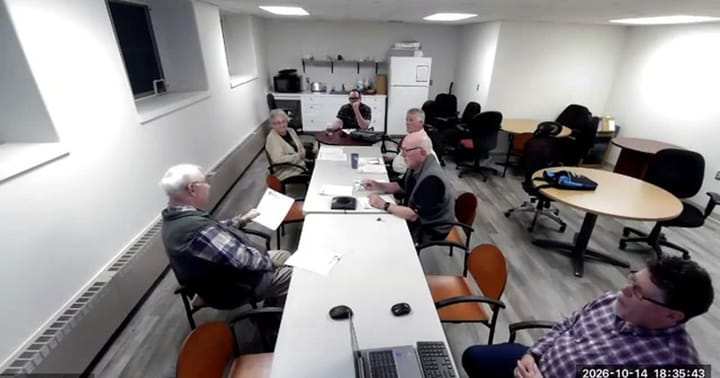
Water Pollution Control · Meeting of October 14, 2026
OLD SAYBROOK — The Old Saybrook Water Pollution Control Authority finalized draft language for a request for qualifications seeking an environmental engineering consultant, targeting an Oct. 26 public notice and a Nov. 23 noon submission deadline. Members approved September minutes and an operating budget on unanimous voice votes. A longtime member announced plans to resign once a current sewer installation project is complete, recommending professional engineer and Inland Wetlands Commission member Julie Bjorkman as a possible successor.
Subcommittee members said they would meet with First Selectman Carl Fortuna on Oct. 15 to secure sign-off before publishing the RFQ in the Hartford Courant and New London Day. Members also reviewed an athletic field turf remediation project, noting a 10 percent retainer remains withheld pending state sign-off, and discussed Old Lyme's failed Soundview sewer referendum, which drew "72% opposed" after a $9.4 million town appropriation.
In the full story:
- Who Was There
- Organizations And Documents Referenced
- The complete report — 2,026 words
Source: the Water Pollution Control meeting of October 14, 2026, reported from the official video recording and transcript.
The Full Article
Call to Order and Roll Call
The Water Pollution Control Authority convened at 6:32 p.m. with a roll call that found the body short of a full complement of members. A member identified only as present for seating purposes was added to the voting roster to establish quorum, a routine procedural step that consumed little time but is worth noting because the authority has operated recently with vacant or unfilled seats, a point that became more pointed later in the meeting when a longtime member announced his intent to resign.
Approval of Minutes and Operating Budget
Members approved the September 14 regular meeting minutes on a motion by Robert Sanger, seconded by fellow member Jay Kulowicz, with no discussion and a unanimous voice vote. The authority then took up its operating budget, presented in the form of undated backup materials that one member characterized as "the proposal" rather than a final document. The authority's regular administrator, referred to in the meeting only as Gratia, was absent and did not present the budget line items herself; members had no questions and approved it on a unanimous voice vote without discussing specific dollar figures.
Member Comments: Septic Complaint Follow-Up and a Planned Resignation
The most substantive member comment of the evening came from a longtime WPCA member who used his open comment period to report back on a resident complaint the authority had taken up previously involving a broken septic tank. He told members he visited the property and found that a fiberglass tank had apparently cracked during installation, on the outlet side, and had been functioning as a single-chamber unit ever since rather than the two-chamber design intended. He said the tank's filter was relatively clean and that the homeowner, a husband and wife, was not pursuing compensation at the time he last spoke with them.
The same member then pivoted to an announcement with longer-term implications for the authority's composition: he said he intends to resign once the authority completes installation of a new sewer system in his area, citing his age. "I'm getting too damn old," he said, before adding that he would like to see a replacement recruited from the specific neighborhood currently being sewered. He suggested Julie Bjorkman, whom he described as a professional engineer, an independent consultant, and a current member of the Inland Wetlands Commission, as a possible successor, noting she lives near Great Hummock in a neighborhood not yet connected to sewer service. Another member noted that any replacement would require formal appointment by the Board of Selectmen rather than direct recruitment by the authority itself. No vote or formal action followed; the discussion ended with members agreeing informally that the member would continue serving until a successor is identified.
RFQ Subcommittee Report: Environmental Engineering Services Solicitation
Background and stakes: The authority has been developing a request for qualifications to retain an engineering firm to conduct an environmental impact evaluation connected to the town's wastewater disposal planning, work that ties into eligibility for state Clean Water Fund reimbursement. The draft under review built on a solicitation the town of Coventry used for a similar project, which one subcommittee member said he located independently by using an AI chatbot to search for recent Connecticut environmental impact evaluation solicitations; the Coventry document, provided separately by a fellow member, matched what the search returned.
The question before the body: whether to finalize the RFQ's substantive content and procedural requirements so it could be reviewed with First Selectman Carl Fortuna and published as a legal notice.
Substantive content: Members worked line by line through the draft. They corrected a reference that had named "subsurface disposal system" inconsistently with the primary alternative, a packaged membrane bioreactor paired with subsurface dispersal, agreeing to add the missing cross-reference. They debated whether to require that any responding firm have experience specifically in "shoreline areas," with one member arguing the phrase would needlessly narrow the pool of eligible firms and should be struck in favor of broader language limited to environmental impact assessments and evaluations under the Connecticut Environmental Policy Act, known as SEPA. A second member pushed back, noting that shoreline-specific regulatory experience carries real value given the number of coastal agencies and permitting bodies a firm would need to navigate in Old Saybrook, though the group ultimately agreed the scope language in the draft was sufficient without an explicit shoreline requirement.
On qualifications, the group settled on requiring that responding firms demonstrate "at least two" similar Connecticut projects rather than a fixed number tied to project scale or a specific lookback period, reasoning that an overly narrow requirement could discourage submissions; interview-stage questions could probe project scale and timing later. Page limits were set at 20 pages for the qualifications submission itself, a number members said was based on professional judgment about what respondents need to adequately describe their experience rather than an arbitrary figure. Members agreed electronic-only delivery would eliminate disputes over formatting (font size, spacing) and timing, since a time-stamped electronic submission removes ambiguity about whether a late submission should be disqualified. One member recalled a past instance on a construction bid where a submitter who was the apparent low bidder was disqualified for missing a deadline by minutes, illustrating the stakes of a hard electronic cutoff.
The deliberation: The exchange over scope language was the meeting's most substantive disagreement. "I'm not used to seeing set pages of text as a legal notice," one member said, raising a cost concern about printing a lengthy notice in a newspaper versus posting the full solicitation online with an abbreviated newspaper teaser directing readers to the town website. Another member worried that approach might not satisfy state Department of Energy and Environmental Protection requirements for public notice under the qualifications-based selection process; members ultimately agreed to run a full legal notice in at least two newspapers, the Hartford Courant and the New London Day, rather than risk a procedural deficiency.
Procedural steps and outcome: No formal roll-call vote was taken on the RFQ language; members reached informal consensus, with one summarizing, "we're in agreement on these words." The subcommittee, with input from the full group, agreed to seek a meeting with Fortuna on Oct. 15 to get his sign-off before publication. Members tentatively settled on an Oct. 26 (a Monday) posting date, giving respondents a four-week window and setting a submission deadline of noon on Nov. 23, timed to close before the Thanksgiving holiday.
Implications and what is next: The RFQ's publication date and firm selection will determine the pace of the town's next wastewater infrastructure environmental review, with the Clean Water Fund reimbursement process requiring documentation such as a newspaper posting affidavit that members flagged as needing early attention from administrator Gratia, who members said has not previously managed a solicitation of this kind.
Athletic Field Turf Remediation Update
Background and stakes: The authority received an update on remediation work at the town's athletic field, a project connected to a subsurface wastewater disposal system under the authority's purview given the volume of flow involved.
Substantive content: A member reported that the project consultant, identified as Pam Lestorti, worked with Chuck Sherwood of the Fields Group, who brought in a turf specialist from Gillette Stadium. Crews rolled the field at 45-degree angles to address surface undulations, aerated at a density of 25 aeration points per square foot, reseeded, and top-dressed with sand sourced from Cape Cod before fertilizing. The member said a recent heavy rain washed some sand off the field into a nearby driving area but not enough to be significant, and that the field should be ready for use next year.
The deliberation: Members noted ten percent of the project retainer remains withheld pending a final sign-off letter, and that oversight of the subsurface disposal component has shifted from the Department of Energy and Environmental Protection to the Department of Public Health's subsurface section, because the system handles roughly 10,000 gallons per day, above the 5,000-gallon threshold that triggers a nutrient evaluation requirement. A member who had spoken with a contact identified only as Carlos said "the check is in the mail" regarding the outstanding retainer payment.
Implications and what is next: Members said they consider the matter largely resolved from the authority's standpoint, having provided what one called "an expert from Gillette Stadium," and will continue monitoring the pending state sign-off before the retainer is released.
Regional Context: Old Lyme Soundview Sewer Referendum
Members closed discussion with an update on a neighboring town's sewer funding effort. Old Lyme's December referendum to fund a public sewer extension into the Soundview area failed, with 72 percent of voters opposed, after the town had appropriated $9.4 million for the project and sought additional funds that were also rejected. Members noted residents from areas including Hawk's Nest and Miami Beach are now petitioning to connect to differing sewer systems, creating what one member called a "cluster" of competing governance and policy questions for Old Lyme's water pollution control authority to sort out, particularly since the town currently cannot spend further money on the project.
Public Comment and Adjournment
No members of the public joined the virtual meeting during the public comment period. The authority adjourned at 7:31 p.m. on a unanimous voice vote.
Jason Becker, member, present per roll call. Ian Featherstone, member, marked "not yet" present at roll call; attendance status thereafter unclear from the transcript. Jay Kulowicz, member, present; seconded the minutes motion. Robert Sanger, member, present; made the motion to approve minutes. A roll-call entry transcribed as "Kathleen" and "Frederick" could not be reliably parsed as one or two members; status unclear. Peter Stump, member, marked not present at roll call. Michael Dallard, apparently present and self-identifying during roll call; role within the meeting (e.g., presiding officer) not explicitly stated in the transcript. Gratia, WPCA administrator/staff, absent from the meeting; operating budget and report submitted on her behalf. Carl Fortuna, identified by name as a town official the subcommittee planned to meet with for RFQ sign-off; the transcript's reference to "the first selectmen" immediately following discussion of Fortuna suggests but does not explicitly state he holds that title. Julie Bjorkman, professional engineer and member of the Inland Wetlands Commission, named as a possible WPCA appointee; did not attend. Pam Lestorti, named in connection with the athletic field project; role or title not stated in the transcript. Chuck Sherwood, identified in the transcript as "the Fields Group consultant" for the athletic field project. Carlos, identified only by first name, a contact at a state agency (DEP or DPH) regarding the athletic field retainer and sign-off. No members of the public attended or commented.
Connecticut Department of Energy and Environmental Protection (DEP) — cited as the agency whose qualifications-based selection guidance governs public notice requirements for the RFQ, and as the former overseer of the athletic field's subsurface disposal sign-off. Connecticut Department of Public Health (DPH), subsurface section — now overseeing sign-off on the athletic field's subsurface disposal system due to its 10,000-gallons-per-day capacity. Town of Coventry, Connecticut — its prior environmental impact evaluation RFQ served as the model document for Old Saybrook's draft solicitation; members noted it drew a single respondent. Fields Group — turf consultant firm, represented by Chuck Sherwood, involved in the athletic field remediation. Gillette Stadium — provided an outside turf specialist who advised on the athletic field remediation work. Inland Wetlands Commission — current body on which proposed WPCA candidate Julie Bjorkman serves. Board of Selectmen — the appointing authority for any new WPCA member, referenced in the resignation discussion. Hartford Courant and New London Day — newspapers members agreed to use for the RFQ's public legal notice. Connecticut Environmental Policy Act (SEPA) — the statute defining the environmental review process the RFQ's scope is built around. Clean Water Fund reimbursement application — state program cited as requiring proof of newspaper posting affidavits for the RFQ process. Old Lyme Soundview sewer referendum (December) — cited as regional context; failed with 72 percent opposed after a $9.4 million town appropriation for a public sewer project.
Share this story
Know someone in Old who follows town government? Share Townbrief Old: they can sign up free.