Mariner's Way panel weighs TIF district expansion
The Old Saybrook Mariner's Way Committee weighed whether to extend its tax increment finance district to include a riverfront redevelopment project near Ragged Rock Marina.
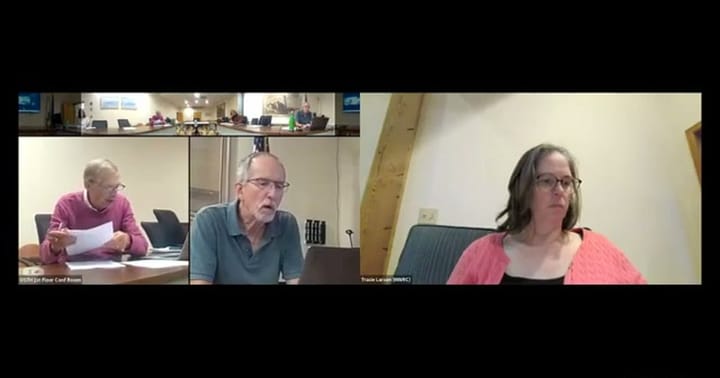
Other Committee · Meeting of September 24, 2026
OLD SAYBROOK — The Old Saybrook Mariner's Way Committee weighed whether to extend its tax increment finance district to include a riverfront redevelopment project near Ragged Rock Marina. Committee chair Bruce said the existing TIF fund holds between roughly $100,000 and $225,000, collected from Mariner's Way properties since the district's 2019 creation, and could help pay for a sidewalk connection to the river. Member Emily questioned whether expansion would "siphon off" funds owed to the original district, asking, "Is there a way for that money to be committed to the current TIF district versus be siphoned off if we did this expansion?" No vote was taken; the TIF advisory board meets again October 20.
Separately, member Doug presented a zoning matrix proposing a new Mariner's Way zone while preserving the Marine Industrial zone, and member Casey outlined a points-based design-standards concept modeled on programs in Los Angeles and Portland, Oregon.
In the full story:
- Who Was There
- Organizations And Documents Referenced
- The complete report — 3,258 words
Source: the Other Committee meeting of September 24, 2026, reported from the official video recording and transcript.
Checked against the record: before publication this article was automatically compared with the meeting transcript.
The Full Article
Additional Consultant Hours Through RiverCog
Background and stakes: The committee raised the possibility of using RiverCog economic development consultant Dale Crook's services several months ago but had not followed up. RiverCog, the regional council of governments, contracts with Crook and distributes his hours across member towns, some of which use only a handful of hours each.
The question before the body: Whether the committee has a specific enough project to justify requesting consulting hours from Crook, and whether those hours would overlap with hours the town's Economic Development Commission is separately requesting.
Substantive content: Town staff member Jennifer told the committee she had a video call with Crook the same day and learned "not every town has opted in to use him, and some of the towns that did only used, like, five hours." She said Crook prefers defined tasks over open-ended engagements because of his limited hours, and that he is developing training modules, including one on performance metrics, that towns can access without using individual hours. Bruce explained Crook's background: more than 20 years as an economic development official for the town of Hamden before retiring, after which he won a competitive RFP to contract with RiverCog. Jennifer noted the Economic Development Commission is separately planning to use Crook for business retention, cluster analysis and training, a scope the Mariner's Way Committee reviewed from a RiverCog services list Jennifer had circulated, focusing on bullet points under "neighborhood and main street business."
The deliberation: Bruce proposed inviting Crook to speak at a meeting of Mariner's Way business and property owners about retention and expansion strategies, framing it as collaboration rather than the committee "doing something to" business owners. Committee member Doug suggested asking Crook to lay out a roadmap, "say the timeframe is two years. What's a reasonable two year roadmap? And are we on track for that?" Committee member Casey asked whether the outreach should target property owners, business owners, or both, since their interests "are sometimes aligned and sometimes might be a little bit different." Bruce also raised an unrelated, longstanding request: a consolidated matrix of state and federal funding programs for economic and community development. He said he raised this with Matt Progrese, a state deputy commissioner, who indicated the next administration may pursue something similar but is not focused on it currently. Doug noted his own experience chasing sea-level-rise funding across "state, federal... a lot of universities," calling a single consolidated list unlikely but worth asking Crook about, given his brownfields expertise.
Procedural steps and outcome: No motion was made. The group agreed informally to let Jennifer continue coordinating with RiverCog contact Susie Beckman about whether two simultaneous Mariner's Way requests, a stakeholder meeting and a funding matrix, are feasible given Crook's limited hours.
Implications and what is next: Jennifer will follow up with Susie Beckman at RiverCog on hour availability. Bruce indicated the business-owner outreach meeting is more likely to happen once the streetscape plan is further along, giving the committee a concrete proposal to discuss with property owners rather than an open-ended conversation.
Tax Increment Finance District: Possible Expansion to Include Riverfront Redevelopment
Background and stakes: The Mariner's Way TIF district was established in 2019, its boundaries drawn from the 2017 Civic Moxie planning study. A separate riverfront redevelopment effort near Ragged Rock Marina is now underway, led by a contact Bruce referred to as Walker Potts, and a newly formed TIF advisory board has begun meeting to consider funding requests across the town's TIF districts.
The question before the body: Whether the Mariner's Way Committee should recommend extending the existing TIF district's boundaries to include the riverfront redevelopment area, a question the TIF advisory board put to Bruce directly ten days before this meeting.
Substantive content: Under the TIF mechanism, 50 percent of the year-over-year increase in assessed value on enrolled properties is deposited into the TIF account; the remainder goes to the general fund. Bruce said the fund currently holds between roughly $100,000 and $225,000, accumulated since 2019 before significant redevelopment has occurred. He noted that Mariner's Way itself only extends down Ferry Road as far as Ragged Rock Marina, leaving a gap in sidewalk infrastructure between the marina and the river that TIF funds could help close if the district expanded. Eligible uses for TIF funds include infrastructure like sidewalks and programs such as a facade improvement grant previously discussed for Mariner's Way businesses.
The deliberation: A committee member, speaking before being identified later in discussion as Emily, asked a process question: "First, if the advisory board or who decides that it's going to fund the sidewalks or it's going to fund a facade improvement, like who's the person who decides that?" [00:31:15] Bruce explained the TIF advisory board is advisory to the Board of Selectmen, which would route funding requests through the Board of Finance and ultimately a town meeting vote, following the town's standard capital-funding process. Emily pressed further on whether accumulated funds from the original Mariner's Way district might instead flow toward the newer riverfront project: "is there potential that all these funds that have amassed so far will continue to grow, that are from the original district will get claimed and mostly spent on the other district... even though they've been the ones paying it." Bruce responded that Mariner's Way property owners are not paying extra taxes into a dedicated pool; the increment simply reflects town-wide tax revenue being reinvested in the TIF area, benefiting anyone who develops there. He added that if the riverfront property enters the TIF district, "that massive increase in their taxes, going from where they are now to a newly developed, more valuable property, will give a big boost to the whole TIF district," though he acknowledged the riverfront development will likely be built and financed before new TIF dollars materialize. Emily reiterated her original concern directly to Bruce: "We've got money in the bank today. Is there a way for that money to be committed to the current TIF district versus be siphoned off if we did this expansion?" [00:37:43] Bruce agreed to raise the question with Walker Potts before the advisory board's next meeting. Doug added a process observation, noting that any funding request ultimately gets weighed by the Board of Selectmen against townwide priorities, not simply approved because a project asks for it: "is this the right thing to do for old Saybrook, and the priority of things, does this fit?"
Procedural steps and outcome: No motion or vote occurred. Bruce said the TIF advisory board meets again October 20 and that he would report the committee's informal sentiment, noting the committee also plans to request TIF financing for a Mariner's Way soils analysis, a use he called clearly "appropriate" for the fund.
Implications and what is next: The committee's position, to be shaped before October 20, will influence whether revenue generated by Mariner's Way property owners since 2019 remains dedicated to that corridor's infrastructure and facade grants or is shared with the riverfront redevelopment area as that project moves forward.
Draft Communication to Mariner's Way Property Owners
Background and stakes: Bruce said he has wanted to send an update to Mariner's Way property and business owners for some time but waited until there was enough substance to report. He drafted a letter, which Tracy and Jennifer then edited for tone and clarity.
The question before the body: Whether the committee is comfortable with the letter's content and tone before it is finalized and distributed by email and posted online.
Substantive content: The letter covers streetscape planning, a proposed soils analysis along Main Street properties to assess infill housing potential and septic capacity, and upcoming zoning changes. Members edited several passages: a sentence describing projects as "coming to fruition" was softened to say activities "are in motion," since Bruce worried it implied an imminent finish line; a reference to possible design "modifications" was clarified to specify these would occur "within state design standards"; the phrase "additional septic capacity" was changed to "total septic capacity" at a member's suggestion; and a zoning section was revised to reassure residents that changes aim to "expand opportunities" rather than impose "radical zoning change."
The deliberation: Doug questioned the term "infill housing," saying it "came across to me as gray and would raise questions," prompting the committee to consider whether the term needed more explanation or should be dropped. Jennifer confirmed Larry, a town web staffer, had begun separating a Mariner's Way section on the town's site, though it does not yet have its own dedicated page; Bruce asked her to look into creating one so the letter and future updates could be posted for owners without email addresses on file.
Procedural steps and outcome: No formal vote. The committee reached informal consensus on the edits. Bruce and Jennifer will finalize the letter, distribute it by email to Mariner's Way property and business owners, and post it online once available; the committee will be copied on the final version.
Implications and what is next: This is the committee's first direct outreach to the corridor's property and business owners. Its tone, measured rather than definitive, reflects the committee's effort to avoid alarming owners about zoning changes still under discussion.
Zoning: Subzones, Marine Industrial Protections and Housing Limits
Background and stakes: Following two prior work sessions, Doug prepared a spreadsheet comparing uses permitted in the corridor's four existing zones, Marine Industrial, Industrial, B3 and B4, against what would be allowed under a single proposed new Mariner's Way zone.
The question before the body: Whether to consolidate the four existing zones into one new Mariner's Way zone outright, or preserve some zone distinctions, particularly around industrial land and housing, through a subzone structure.
Substantive content: Doug's matrix organizes uses by category, including manufacturing, housing and recreation, marking changes the committee had previously agreed to. Members confirmed the Marine Industrial zone, protective of waterfront uses, would not be altered and would not be absorbed into the new zone. Discussion then turned to the large industrial-zoned parcel on the corridor's south side, described as the "B&L property," with members debating whether its Glade View-facing portion should convert to the new Mariner's Way zone while the rear portion remains industrial. Bruce proposed treating this as a subzone within the broader Mariner's Way zone rather than a binary industrial/non-industrial split, reasoning that regulatory changes made within a subzone would not unintentionally apply to industrial zones elsewhere in town. Casey, identified as a zoning commission member, agreed, explaining a separate zone "unifies the area a little bit more" while containing changes, such as new building-form standards, to that specific area.
On housing, the matrix showed accessory dwelling units struck from the new zone's permitted uses except for housing that existed before a cutoff date, since the committee had previously agreed not to encourage new single-family housing stock along the corridor. A special-exception designation near Glade View, intended "to avoid overtaking area," drew scrutiny: Doug explained the concern was that a developer could acquire a large parcel and fill it entirely with age-restricted or affordable housing, bypassing the committee's preference for mixed uses. Casey noted that industrial-zoned land is exempt from the state's 8-30g affordable-housing statute, meaning a special-exception designation, rather than by-right permission, would preserve the committee's ability to negotiate conditions. Bruce asked the broader question directly: "Why would we want to limit housing along the way? If the development community came in and said, we'd like to put these lots together and create housing, is that something necessarily that old civil people would now want to see?" Doug responded that industrial development generates higher tax revenue than housing and benefits from the parcel's highway access, an advantage the Marine Industrial zone's protections don't extend to this area; he also cited input from Chris Costa that certain long-term industrial uses on the B&L property are unlikely to change and are not uses people would want to live near.
Procedural steps and outcome: No vote was taken. The committee agreed informally to flag the need for a subzone structure in its working notes and to bring a zoning map to a future meeting to delineate specific subzone boundaries before finalizing housing rules.
Implications and what is next: The committee's next zoning session will likely involve a map exercise to define subzone boundaries, directly shaping where new housing, industrial uses and mixed development can locate along Mariner's Way.
Site Design Standards: A Points-Based Alternative to Special Exceptions
Background and stakes: The committee has been developing lot and bulk requirements for the corridor and considering how far it can go, statutorily, in imposing design standards beyond the town's existing architectural review process.
The question before the body: Whether a points-based design-standards system, rather than case-by-case special exception review, could better balance flexibility for existing businesses with predictability for new developers.
Substantive content: Casey described systems used in other jurisdictions, including Los Angeles and Portland, Oregon, modeled loosely on LEED certification, where developers earn points toward approval by meeting criteria the community prioritizes, such as landscaping, building form or preserving existing businesses, while mandatory baseline requirements remain non-negotiable. She noted an unnamed town's transit-oriented district requires developers to consult a town-retained architect, a service she said is funded through some combination of public and private sources she could not fully confirm. She separately described work from her prior role in Wallingford's transit-oriented district, where parking requirement reductions were offered as incentives for amenities like public open space. Casey also presented results from an earlier committee survey of building images, noting that structures members rated most negatively, including one described as having prominent bay doors and little glazing, would likely pass under the corridor's current design guidelines, while some favored images would fail, illustrating a mismatch between committee preferences and existing rules.
The deliberation: Doug and Casey agreed a points system would be easier to contain within a new Mariner's Way subzone than if layered onto existing townwide zones. Casey argued the approach reduces the discretionary, negotiation-heavy character of special exception review: "I know if I give this, I get that. Whereas right now, that is sort of what happens... but you don't actually know until you've... spent all the money to make your presentations." Doug cautioned that the points framework still requires careful calibration to avoid approving the very building forms the committee has said it dislikes. Casey suggested consulting the town's Architectural Review Board to identify which design elements members consider non-negotiable before finalizing a points structure.
Procedural steps and outcome: No vote was taken. Casey agreed to continue developing the points-based concept and the building-form survey analysis for a future meeting, coordinating with Doug's site design work so the two approaches do not conflict.
Implications and what is next: If adopted, a points-based system would represent a departure from the corridor's current special-exception process, potentially increasing predictability for developers while giving the committee explicit leverage to incentivize features, such as preserving existing businesses, that current rules do not reward.
Soils Analysis and Infrastructure Update ("Soros")
Background and stakes: An outside firm referred to in the meeting as Soros is conducting a preliminary analysis expected to inform a funding request, tied to the soils analysis referenced in the draft property-owner letter.
The question before the body: Whether the firm has a completion date or cost estimate the committee needs for upcoming funding decisions.
Substantive content: Doug, who had not been in contact with the firm recently, said contacts identified only as Brian and Josh have the relevant files and are moving the analysis along, but no dollar figure or completion date is available yet. The firm plans to bring its analysis to the committee before providing a funding estimate.
Procedural steps and outcome: No vote. Doug agreed to email the firm the next day, copying Tracy and a contact referred to only as Chris, and to flag the committee's October 8 meeting date in case a preliminary update or completion-date projection is available by then.
Implications and what is next: The analysis will inform the committee's forthcoming TIF funding request for the soils study, which Bruce said he hopes to quantify before the TIF advisory board's October 20 meeting.
WHO WAS THERE
Bruce, committee chair, presided over the meeting, led the TIF and RiverCog discussions, and reported on his outside conversations with the TIF advisory board, Walker Potts and Matt Progrese. Doug, committee member, presented the zoning use matrix and the Soros project update. Casey, committee member and zoning commission member, presented the points-based design standards concept and the building-image survey results. Tracy, committee member, participated by remote connection and reviewed the draft property-owner letter. Emily, committee member, raised questions about TIF district fund allocation and equity between the Mariner's Way and riverfront areas. Jennifer, town staff, liaised with RiverCog, drafted letter edits, and reported on the town website's Mariner's Way page. No members of the public attended in person or virtually. Dale Crook, RiverCog economic development consultant, was discussed as a potential resource but did not attend; a former 20-year Hamden economic development official now contracting through RiverCog. Susie Beckman, RiverCog contact, to be consulted on consultant hour availability. Walker Potts, contact involved in the riverfront redevelopment project, to be consulted on TIF district expansion. Chris Costa, town official cited regarding long-term industrial uses on the B&L property. Matt Progrese, state deputy commissioner, cited regarding a possible future state funding-program matrix. Larry, town staff, cited regarding the Mariner's Way web page. Brian and Josh, contacts at the firm referred to as Soros, working on the soils and infrastructure analysis. Chris, a contact to be copied on Doug's follow-up email regarding the Soros project; surname not stated.
ORGANIZATIONS AND DOCUMENTS REFERENCED
RiverCog (Lower Connecticut River Valley Council of Governments) — employs consultant Dale Crook and was the subject of discussion about additional staff assistance hours for the committee and the Economic Development Commission. Old Saybrook Economic Development Commission — separately planning to use Dale Crook for business retention, cluster analysis and training, discussed to coordinate hour usage. Civic Moxie — authored the 2017 study whose recommendations established the Mariner's Way TIF district's original geography in 2019. Mariner's Way TIF advisory board — met roughly ten days before this meeting, asked whether the committee supports expanding the TIF district, and will meet again October 20 to receive the committee's response. Board of Selectmen, Board of Finance, and town meeting — described as the sequential approval process any TIF-funded project would need to pass through. Architectural Review Board — referenced as a resource the committee should consult to identify non-negotiable design priorities before finalizing a points-based design system. Zoning Commission — referenced as the body to which any zoning subzone recommendations would ultimately go. State statute 8-30g (affordable housing) — cited by Doug and Casey regarding why industrial-zoned land is exempt and how that affects housing permitting strategy near Glade View. Draft Mariner's Way property-owner letter — reviewed and edited line-by-line regarding streetscape, soils analysis, and zoning language. Doug's zoning use matrix spreadsheet — compared existing Marine Industrial, Industrial, B3 and B4 zone uses against a proposed new Mariner's Way zone. Casey's building-image survey and points-system materials, including examples from Los Angeles and Portland, Oregon — used to illustrate gaps between current design guidelines and committee preferences. Soros (referred to by that name in the meeting) — outside firm conducting a soils and infrastructure analysis for the Mariner's Way soils project, update pending as of this meeting.
Share this story
Know someone in Old who follows town government? Share Townbrief Old: they can sign up free.