Youth Commission Previews 45-Provider Wellness Expo
The Old Saybrook Youth and Family Services Commission reviewed plans for a 45-provider wellness expo and new prevention grants, taking no votes beyond approving minutes.
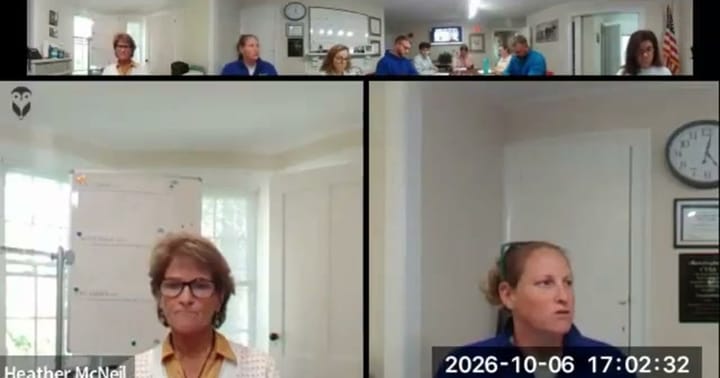
Other Committee · Meeting of October 6, 2026
OLD SAYBROOK — The Old Saybrook Youth and Family Services Commission reviewed plans for a 45-provider wellness expo and new prevention grants, taking no votes beyond approving minutes. Director Heather McNeil said the department secured a $10,000 nicotine-prevention grant and a $3,000 problem-gambling grant, with a $50,000 cannabis-prevention grant pending. Program coordinator Brittany Eckert said a youth survey found 97 percent of students believed their parents would disapprove of vaping, a figure the department plans to use in a social-norms campaign.
The expo, co-run with the Lions Club, will offer free flu and RSV vaccinations, EMDR counseling resources and chair massages on a Saturday from 1 to 3:30 p.m. McNeil also previewed a possible community needs assessment, telling the commission "I'll bring it to the commission to see what you all think before it's decided upon." Members separately discussed reviving interest in a town skateboarding club following the closure of Old Saybrook's skate park roughly two decades ago.
In the full story:
- Who Was There
- Organizations And Documents Referenced
- The complete report — 2,988 words
Source: the Other Committee meeting of October 6, 2026, reported from the official video recording and transcript.
Checked against the record: before publication this article was automatically compared with the meeting transcript.
The Full Article
Call to Order and Minutes
The commission chair opened the meeting, confirmed no members of the public had dialed in, and the body approved the minutes of its previous meeting on a voice vote with no discussion. This was purely procedural and consumed less than two minutes.
Chair's Remarks
The chair, unnamed in the transcript, opened with brief remarks on the start of the school year and the breadth of the Youth and Family Services Department's work, from prevention education to the upcoming wellness expo. "It is just a great resource in town that just touches on so many different aspects of the community and covers a lot of ground with a very small staff," the chair said. [00:01:44] No vote or decision followed; the comment set the tone for the meeting's heavy presentation load from department staff.
One Book, One Town: Local Authors Take Center Stage
Background and stakes: The Early Childhood Council's annual "One Book, One Town" initiative typically centers on a single children's book; this year the department shifted the focus to spotlighting local authors directly, an approach staff said was meant to show students that writing itself, not just reading, is attainable.
The question before the body: This was an informational update, not a decision item.
Substantive content: Director Heather McNeil turned the item over to program coordinator Brittany Eckert, who described visits by three local authors: Jody Kelly, who has published four children's books and read to students at Goodwin School and at the Acton Public Library, where Eckert said the story-time crowd was "actually all boys and maybe two girls"; Cinco Stedman, author of a book Eckert referred to as "Steamed Dance," who is scheduled for eight classes at Goodwin and a reading at Gladeview, a site the department also visits with students for intergenerational programming; and Trent Gerber, a town Board of Education employee whose chapter book targets second grade and older. Readings were also scheduled for Goodwin's "specials" classes.
The deliberation: The chair noted having recently learned, through an interview Eckert shared, that Gerber also has music albums and writing credits the chair had not known about despite a long working relationship with him. The chair connected the authors' classroom visits to a broader observation about writing instruction in an era of artificial intelligence tools, describing writing "as a process rather than a product and as a way to organize your thinking." Eckert responded that watching Kelly explain her watercolor versus hand-drawn illustration choices let students see "the picture tells the story, not just the words."
Procedural steps and outcome: No vote; the item concluded with a note that the authors will also read at the wellness expo.
Implications and what is next: The author program folds into the wellness expo's programming and into Goodwin School's ongoing "specials" curriculum, with no additional cost cited.
Wellness Expo and Community Collaborations
Background and stakes: The Lions Club and the Youth and Family Services Department have co-run a health fair for three years. This year a Lions Club contact named Renee approached the department to expand the mental-health component, reflecting what Eckert described as a persistent community difficulty connecting to clinical services.
The question before the body: Staff briefed the commission on expo logistics and presenter recruitment; no formal approval was required since the event is already planned.
Substantive content: Eckert said the expo has secured 45 presenters, the largest roster yet. Mental health providers include Hopewell Health, which Eckert said has a new Westbrook location and other sites in Glastonbury; Clearview Consulting, a marriage and family therapy group near the Staples store; and an independent EMDR specialist. Physical-health presenters include the town's public health nursing board, the Connecticut River Area Health District (offering flu and RSV vaccinations and, per staffer Camila, blood-pressure and glucose checks), the Lions Club's KidSight children's vision-screening program, and One Sound Recovery, a chiropractic service providing free chair massages. The American Red Cross and American Cancer Society will staff donation and information tables, and every table was asked to bring a giveaway, such as stress balls. Logistics: the event runs 1 to 3:30 p.m. to avoid competing with Saturday morning soccer, with $7 boxed lunches from Mindy K's, a Kona snow-cone van, children's activities, and appearances by the fire department, police department and an ambulance crew.
The deliberation: A commissioner asked how attendees would know who the presenters are; Eckert said a QR code at the event links to a full presenter directory with websites. The group briefly discussed adding "baby goats" to the children's activities, which drew agreement without objection.
Procedural steps and outcome: No vote; this was a status update ahead of the event.
Implications and what is next: Residents who attend the expo gain access to free vaccinations, screenings and mental-health consultations in a single venue, continuing a model McNeil's department has run for three years with the Lions Club.
Grants Report: Nicotine, Gambling and Pending Cannabis Funding
Background and stakes: The department's prevention programming is substantially grant-funded, and McNeil said she deliberately limits how many revenue streams the small staff pursues at once to avoid overextension.
The question before the body: An informational report on current and pending grants, with McNeil flagging a future proposal (the community needs assessment, covered separately below) that would require commission input.
Substantive content: McNeil said total grant funding rose this year, citing a new $10,000 nicotine-prevention grant as the primary driver; she was not certain of the exact total increase in the moment, saying "not sure the six... it was three and three," before estimating the total increase at roughly $6,000 beyond the $10,000 award. A $50,000 cannabis-prevention grant application is pending. Separately, a $3,000 grant funds problem-gambling prevention work with the Problem Gambling Council of Connecticut; McNeil said a national speaker, a former college athlete, will address seventh- and eighth-graders and grades nine through 12 in March, Problem Gambling Awareness Month, and that she has contacted Athletic Director Brennan Saunders about pairing the message with a parent-and-athlete evening. McNeil said a state-commissioned study found 1.8 percent of gamblers generate 51 percent of platform revenue, a figure a commissioner raised from a class discussion rather than department research.
Eckert detailed the nicotine grant's social-norms strategy, built on the department's prior Youth Voices Count survey finding that 97 percent of surveyed students believed their parents would disapprove of vaping. The campaign will publicize the low prevalence of youth vaping rather than repeating higher, attention-grabbing numbers. The department is distributing daily age-verification calendars to retailers, conducting "environmental scans" of stores selling nicotine products near schools, and assembling cessation "quick kits" with a peer-support text line for students already using nicotine products, which Eckert said increasingly take the form of pouches rather than vapes because they are easier to conceal.
The deliberation: A commissioner noted anecdotally that sports betting had come up in an unrelated class discussion, prompting McNeil's gambling-grant summary. No disagreement was raised on any grant figures; McNeil's own uncertainty about the exact dollar increase was the only imprecision in the discussion.
Procedural steps and outcome: No vote. McNeil said she will bring a related funding proposal, the community needs assessment, to the commission separately for discussion before any decision.
Implications and what is next: The gambling-prevention assembly and parent evening are tentatively planned for March; a date has not been set. The cannabis grant outcome is pending.
Digital Balance Program
Background and stakes: A joint PTO, library and Youth and Family Services event aims to reach parents on digital-literacy topics where they already gather, ahead of a PTO meeting.
The question before the body: Informational announcement only.
Substantive content: Eckert said the program, "finding the digital balance in this online world," covering parental controls and AI tools, is scheduled for Oct. 19 from 5:30 to 6:30 p.m. at the middle school, timed before that evening's PTO meeting.
Procedural steps and outcome: No vote; Eckert left the meeting shortly after this announcement.
Implications and what is next: The event is open to parents the week of Oct. 19.
Camp Hazen Update
Background and stakes: The freshman transition program pairs a school-based team-building day with a ropes-course trip to Camp Hazen, run with upperclassman "link leaders" who undergo an application and training process.
The question before the body: Informational report.
Substantive content: Before leaving, Eckert confirmed roughly 50 students (the group cited both 50 and 56 in passing) took part. McNeil added that the school-based session ran Sept. 15, focused on relationship- and team-building, followed by the Camp Hazen trip. Staff and partners present included Park and Recreation Department staff Taryn and Casey, Acton Public Library's Brian Story, the school resource officer, and ninth-grade teachers and administrators. McNeil said link leaders, who must apply and complete training before freshman orientation, were noted for their patience and encouragement of younger students on challenge activities such as the Alpine Tower.
The deliberation: McNeil and the chair both praised this year's freshman cohort as unusually well-behaved, citing teacher feedback.
Procedural steps and outcome: No vote.
Implications and what is next: The program will be referenced in the department's video report; no changes to its format were proposed.
Volunteers and Community Service
Background and stakes: The department coordinates student community-service placements, particularly to avoid a late-spring rush of requests.
Substantive content: A flyer has gone out for two upcoming events: the wellness expo and a Starlight Festival on Saturday, Dec. 5. The flyer was shared with school guidance teams, and the department collects parent permission and emergency-contact forms for participating students.
Procedural steps and outcome: No vote; this was a brief, roughly two-minute item.
Community Needs Assessment Proposal
Background and stakes: The department previously commissioned a Youth Voices Count survey of grades 6 through 12, run by developer Bonnie Smith's firm, which McNeil said is now used by a large share of Connecticut's youth service bureaus. McNeil said gaps in participation data across town departments, and historically irregular coordination among Youth and Family Services, the Acton Public Library and Park and Recreation, prompted her to revisit Smith's companion community-needs-assessment product for a broader, adult-and-family audience.
The question before the body: McNeil previewed a funding and scope proposal she intends to bring back for commission discussion before any decision.
Substantive content: The prior youth survey cost about $4,500, funded through ARPA money; McNeil said the adult/community version is typically less costly and fully electronic, though sample size can be a challenge. Park and Recreation staffer Taryn said her department has independently considered a similar survey to understand low program registration, and McNeil proposed the two departments coordinate on a shared tool to split costs and share results.
The deliberation: "So when I make that proposal, I'll bring it to the commission to see what you all think before it's decided upon," McNeil said. [00:29:31] Taryn agreed collaboration would help, noting Park and Recreation faces the same difficulty diagnosing low turnout: "it's hard to identify... why one thing's going to run or one thing doesn't."
Procedural steps and outcome: No vote taken. McNeil will return with a formal proposal.
Implications and what is next: If approved, the assessment would be the department's first broad survey of adult residents' perceptions of youth services, potentially reshaping how multiple town departments plan programming to reduce duplication.
Healthy Relationships, Boundaries and Consent Programming
Background and stakes: McNeil connected this item to recent, unspecified news coverage on healthy relationships and safety, and to a free self-defense class the department ran in July.
Substantive content: The July self-defense class, offered to up to 40 students free of charge through a sponsorship arrangement, focused on mothers and daughters, including students departing for college. McNeil said the provider has agreed to run a December session if the department can secure funding, since the sponsorship covered only the first class; she is awaiting a cost estimate. Separately, the department is holding an Oct. 21 tabling event at the high school on healthy relationships, boundaries and consent, with a provocative prompt on the table: "What does no mean to you?" McNeil said the high school has already approved the tabling location.
The deliberation: McNeil asked commissioners whether the programming should extend to younger grades. One member suggested seventh and eighth grade could be appropriate, and another argued consent-related concepts could be introduced even earlier, since "it's consent is consent" regardless of age, though no one proposed a specific younger age cutoff. McNeil asked commissioners to take time to consider the question rather than decide immediately.
Procedural steps and outcome: No vote. McNeil will seek further informal feedback before finalizing programming scope.
Implications and what is next: The Oct. 21 high school tabling event proceeds regardless of this broader-audience question, which remains open for future discussion.
Sector Reports
Background and stakes: Commission members and partner-agency staff give standing updates on their own departments or schools.
Substantive content: A school-based speaker reported the district was administering anxiety screeners that day to students in grades five, seven and 11, conducted twice yearly (fall and spring); students who screen as elevated are connected to school-based groups, individual counseling or the Youth and Family Services Department, with follow-up in the spring. The same speaker said department interns will begin school-based "lunch bunches" with students starting this week, following a Thursday meeting with the guidance department.
Taryn, representing Park and Recreation, said the department will staff a table at the wellness expo and that yoga, tai chi and jazzercise classes have moved to the middle school because the town pavilion is closed. She said the Teen Center's Goodwin-based programs are running well and that a Trunk or Treat event is scheduled Oct. 16.
The deliberation: No disagreement; reports were informational.
Procedural steps and outcome: No vote.
New Commission Members' Observations
Background and stakes: The chair invited the commission's newest members, in roughly their second month of service, to share observations.
Substantive content: One newer member, unnamed in the transcript, asked how families facing financial hardship, such as one recently supported through a community GoFundMe, can access town resources; a department staff member explained that town social services require an income-verification application, which can be slower than an informal community fundraiser, but that staff can connect families confidentially to additional resources without disclosing identities.
A second newer member described a request from her son's friends for a skateboarding club, given the existing mountain-biking club meets only monthly. The group discussed Old Saybrook's skate park, which commissioners said closed roughly two decades ago for lack of interest after initial funding tied to a 501(c)(3) and a "Healthy Community Healthy Youth" initiative. Members compared nearby skate facilities in New London, Manchester and other area towns, noting renewed youth interest in skateboarding nationally.
Kaki, identified as a newer commission member in her second month, reported that nicotine-pouch use appears to have declined visibly at the high school compared with her own time as a freshman, though she said a school custodian found pouches hidden under cafeteria tables, suggesting the behavior may have shifted rather than disappeared. McNeil agreed, saying prevention work tends to "go underground and comes back up" and that consistent messaging at younger ages remains necessary. McNeil added that during the department's retail "environmental scans," most store owners are cooperative once staff explain the visit is informational rather than punitive, and that a state-connected underage-sales compliance check in Old Saybrook within the past eight months found all local retailers passed.
Procedural steps and outcome: No vote; discussion only.
Implications and what is next: No formal follow-up was assigned, though the skateboarding-interest conversation and the mountain-biking club's staffing (a staff member who the group noted "donates a lot of time" running trail outings, generally with another adult present) may inform future Park and Recreation programming discussions.
Adjournment
The commission heard no further old or new business and voted to adjourn. A reminder was given that the next meeting will be held entirely virtually.
WHO WAS THERE
Commission chair — presided over the meeting; name not stated in the transcript. Kaki — newer commission member, second month of service. Two additional newer commission members, unnamed in the transcript, who raised questions on financial-assistance resources and youth interest in a skateboarding club. Taryn — gave the Park and Recreation Department sector report; affiliation stated in transcript. Heather McNeil — Director, Old Saybrook Youth and Family Services Department. Brittany Eckert — program coordinator and certified prevention specialist, Youth and Family Services Department; departed partway through the meeting. Jess — program coordinator, Youth and Family Services Department, referenced as present earlier in the meeting. Camila — present to discuss health-screening logistics for the wellness expo; specific affiliation not fully stated in the transcript. No members of the public called into the meeting.
ORGANIZATIONS AND DOCUMENTS REFERENCED
Early Childhood Council — sponsors the "One Book, One Town" literacy initiative discussed in the authors' segment. Goodwin School — venue for author visits and "specials" classes. Acton Public Library — hosted author story times; staff member Brian Story attended the Camp Hazen program. Old Saybrook Lions Club — co-sponsor of the wellness expo for three years; runs the KidSight vision-screening program. Hopewell Health, Clearview Consulting — mental health providers scheduled to present at the wellness expo. Connecticut River Area Health District — providing vaccinations and screenings at the wellness expo. Problem Gambling Council of Connecticut — partner on the department's $3,000 problem-gambling prevention grant. Camp Hazen — site of the freshman team-building and ropes-course program. Park and Recreation Department — partner on the self-defense class, several youth programs, and a possible joint community needs assessment. Bonnie Smith's survey firm — conducted the prior Youth Voices Count survey (grades 6-12) and offers the community-needs-assessment tool McNeil proposed revisiting. ARPA funding — funded the roughly $4,500 Youth Voices Count survey. "Healthy Community Healthy Youth" initiative / 501(c)(3) — cited as historical funding source for Old Saybrook's former, now-closed skate park.
Share this story
Know someone in Old who follows town government? Share Townbrief Old: they can sign up free.