Pension Panel Pursues $19,048 Overpayment Recovery
The Old Saybrook Pension Committee moved to recover a $19,048 pension overpayment after a retiree's death went undetected.
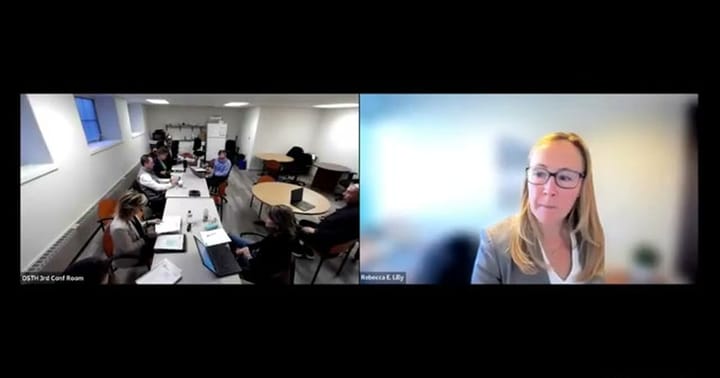
Other Committee · Meeting of October 22, 2026
OLD SAYBROOK — The Old Saybrook Pension Committee moved to recover a $19,048 pension overpayment after a retiree's death went undetected. Sarah, who presents the committee's pension and finance reports, said the town will send a certified letter and may pursue a reverse ACH transaction to retrieve the funds from the family's bank. Amy, who handles pension payment administration, said she "attempted to get in touch with her next of kin and have not had any luck." The committee is also adding a roughly $500-a-year Milliman monitoring service to flag future retiree deaths automatically.
Separately, Board of Finance Chairman George floated redirecting town surplus into pension contributions, which members said they were inclined to decline given the plan's 81.6 percent funded status. Investment advisors from Morgan Stanley reported the pension portfolio underperformed its benchmark by about 100 basis points last quarter but has since rebounded roughly 20 basis points. A recent town bond sale priced about eight basis points below the AAA municipal index at 4.25 percent for 20-year financing.
In the full story:
- Who Was There
- Organizations And Documents Referenced
- The complete report — 2,590 words
Source: the Other Committee meeting of October 22, 2026, reported from the official video recording and transcript.
Checked against the record: before publication this article was automatically compared with the meeting transcript.
The Full Article
Call to Order and Attendance
The committee opened with four members present, though only two were named aloud: Paul and Lorraine. A third member, Rowena, had emailed the prior day to say she would be unable to attend after all despite planning to join from a conference. No members of the public were present. The meeting proceeded informally, with the chair asking for a motion on the only procedural item before moving into substantive reports.
Approval of September Minutes
Members approved the September meeting minutes on a motion and second, with no discussion of content, by unanimous voice vote. This was the meeting's only formal vote.
Pension Liaison Report: Overpayment Recovery and Death-Notification Service
Background and stakes: Municipal pension plans periodically continue paying benefits to retirees after death if the town is not promptly notified, creating overpayments the town must then try to recover. Sarah told the committee this has happened roughly every two years. The current case involves a Board of Education retiree whose death went undetected, producing a $19,048 overpayment.
The question before the body: whether and how to recover the funds, and whether to adopt a new service to prevent recurrence.
Substantive content: Amy, who manages pension payment administration, said she has a cell phone number and an Old Saybrook address for the retiree's family but has been unable to make contact; calling the number produces what she described as "a very peculiar" result, and the address may no longer be current. She has not sent any certified correspondence to date. The committee discussed options including a reverse ACH transaction to pull the funds directly from the family's bank, which Amy said she has executed successfully before, including once for nine months of payments, though never for an amount this large. Members also raised checking with probate court for an open estate, which would make the town a creditor able to file a claim.
Separately, Sarah reported that the committee has arranged with Milliman, the plan's actuarial consultant, to add a low-cost monitoring service, roughly $500 annually with a Milliman-negotiated discount, that cross-checks participants' Social Security numbers against national death records to flag deaths automatically going forward.
The deliberation: Members pressed for specifics on the family's whereabouts and the town's prior outreach efforts.
"Is there not a way from our bank to the bank that's being deposited?" [00:05:12] — committee member
Amy responded that she typically gives families advance notice before initiating a reverse ACH so they are not caught off guard, and the committee agreed that approach made sense here as well, with a committee member offering to sign a certified letter informing the family of the town's intent.
Procedural steps and outcome: No formal vote was taken; the committee reached informal consensus that a certified letter be drafted and sent, that Amy pursue a reverse ACH if the family does not respond, and that staff check with probate court for an open estate. Sarah also noted the overpayment would be posted to the town's bad debt line in the interim.
Implications and what is next: Recovery of the $19,048 depends on the family's response to the certified letter and whether a probate estate exists to file a claim against. The new Milliman monitoring service is intended to prevent similar overpayments town-wide going forward.
Plan Participation and Staffing
Sarah reported the Defined Benefit pension plan's gross payroll at $177,425 for 98 town retirees, with a separate fire pension payroll of $17,304 for 42 participants and no new additions to either plan this period. Active contributing employees in the Defined Benefit plan total 63: 26 police officers, 19 town employees and 18 Board of Education employees. In the 401(a) defined contribution plan, Sarah reported 50 contributing town employees and 13 contributing Board of Education employees, for a stated total of 83 active participants. The town's 457 plan has 92 active employees with a total plan balance of $5,625,234. Across defined contribution plans, 78 percent of participants have elected an additional employer match, 88 percent among town employees and 64 percent among Board of Education employees.
The committee also discussed a hiring gap: public works remains down two positions after what was described as a voluntary separation agreement with one employee, and the department has struggled to fill entry-level roles paying roughly $50,000 to $55,000 before benefits, closer to $75,000 with benefits factored in. One new public works hire is contributing the full 8 percent employee match eligible for town matching funds. A member noted that public sector hiring tends to improve when the broader economy weakens, since fewer competing private-sector jobs are available.
Board of Finance Chairman's Pension Funding Inquiry
Background and stakes: The town routinely allocates budget surpluses among several competing uses: building fund balance, funding capital projects to avoid new borrowing, or potentially pre-funding pension obligations beyond required contributions. George, Chairman of the Board of Finance, informally raised whether directing extra money into the pension plan, which assumes a 6.75 percent return, could outperform the roughly 4 percent earned on fund balance or the 4.5 percent interest avoided by funding capital projects with cash.
The question before the body: whether the pension committee should respond to, or discourage, this informal suggestion before it becomes a formal Board of Finance proposal.
Substantive content: Sarah said she asked Milliman to model the scenario and that a hypothetical $500,000 additional contribution would generate savings over the plan's 15-year layered amortization period, weighted more heavily toward savings in later years. She said the town's main pension plan is already on track for full funding under its actuarially determined employer contribution and is funded at 81.6 percent, with the fire plan less well funded and the stronger candidate for any extra contribution, if one were pursued. She emphasized three competing factors: liquidity, accessibility and volatility, noting that money placed in the pension plan "is long gone and you can never get it out," whereas fund balance remains available for emergencies and capital funding retains flexibility and delivers visible infrastructure benefits to residents now.
The deliberation: One committee member said the panel's inclination should be to decline the idea for the time being.
"Would it be helpful for this board to say, no, thank you? 'Cause that's where I'm at in my head based on everything you said." [00:11:06] — committee member
Sarah responded that the proposal has "not been discussed at a Board of Finance meeting yet" and remains "in its infancy," suggesting the committee keep the conversation informal unless the Board of Finance raises it formally. Another member suggested that if the discussion resurfaces, a cashflow report showing the plan needs only about $200,000 in net capital annually, against roughly $120,000 drawn over the last five years, could help illustrate that additional funding is not urgently needed to meet near-term liabilities.
Procedural steps and outcome: No motion or vote occurred. The sense of the committee was to take no action and await any formal referral from the Board of Finance.
Implications and what is next: The proposal remains unscheduled for any public hearing or vote. If the Board of Finance chairman brings it forward formally, the pension committee indicated it would likely respond with analysis emphasizing liquidity and capital-funding benefits over incremental pension pre-funding.
Investment Advisor Report: Market Conditions and Portfolio Performance
Background and stakes: The committee receives a monthly update from its investment advisors on market conditions affecting the pension portfolio and a review of recent performance against benchmark.
The question before the body: how recent interest rate movement and market volatility have affected, and are expected to affect, the pension fund's bond and equity holdings.
Substantive content: Kevin, the committee's investment advisor from Morgan Stanley, said the 10-year Treasury yield rose from about 4.75 percent to a peak near 5.25-5.30 percent over the past month, with market pricing shifting from an expectation of roughly six Fed rate cuts a year ago to roughly three and a half rate hikes now. He said the 30-year Treasury is approaching 6 percent and 30-year mortgage rates now exceed 7 percent, while the 10-year Japanese government bond sits at its highest level in roughly 30 years. He said rising rates create a difficult position for the Federal Reserve, since cutting rates risks more inflation while raising them risks more job losses, many already tied to AI-driven workforce reductions.
On performance, Kevin said the portfolio underperformed its Investment Policy Statement benchmark for the quarter, down 1.38 percent versus a benchmark decline of 0.42 percent, a gap of about 100 basis points, driven largely by a September rotation into cyclical and lower-quality stocks that reversed in October. He said the portfolio has since outperformed the benchmark by roughly 20 basis points on a fiscal-year-to-date basis. Cash generation rose to nearly $800,000. The portfolio's asset allocation stood at roughly 62.5 percent stocks and 37.5 percent bonds and cash, with volatility about one full "turn" below both the benchmark and a standard 60/40 portfolio. The bond portfolio carries a 2.6-year modified duration and a yield to maturity near 5.83 percent, reflecting a long-standing strategy of staying short-duration and overweight short-term bonds, intentionally outside the plan's normal allowable range, as a hedge against further rate increases.
The deliberation: A member asked whether the overweight to short-term bonds had been a deliberate choice or coincidental given how favorably it has performed as rates rose.
"Was that intentional or just lucky?" [00:48:08] — committee member
Kevin said it was intentional, noting the committee had fielded repeated calls over the years to extend duration and had declined each time, reasoning that an inverted yield curve made longer bonds unattractive. He said the strategy would only hurt relative performance if the yield curve inverts again.
Procedural steps and outcome: No vote was required; this was a standing informational report.
Implications and what is next: The committee's short-duration bond strategy continues, with Kevin indicating the firm does not see current conditions as the right time to extend duration.
AI Sector Exposure Discussion
A member asked how to assess the portfolio's exposure to artificial-intelligence-related technology, saying the performance reports provided did not clearly break out AI-specific holdings and he wanted to track the issue given how concentrated AI investment has become in large-cap technology. Rebecca directed him to the sector-exposure page of the performance report, where technology accounts for roughly half the equity allocation, a long-standing underweight relative to the S&P 500 driven by concentration risk and valuation concerns. Kevin said the firm has no specific numerical target for AI exposure, noting that pension portfolios prioritize liability payments, protecting the funding ratio, and only then taking on volatility, which argues against chasing a fast-growing, capital-intensive sector. He said the U.S. has roughly 5,000 AI data centers built or underway compared with an estimated 500 in China. No vote was taken; the exchange concluded with the member indicating he wanted to continue monitoring the exposure informally.
Annual Asset Allocation Study
The committee reviewed its once-a-year risk-platform asset allocation study. Kevin reported the portfolio carries roughly 10 percent less volatility than its benchmark (10.85 versus 11.74), about 60 percent of benchmark bond duration, and a beta near 55 percent relative to the S&P 500. The equity portfolio carries a price-to-earnings ratio of 18.63 against a broader market level Kevin put at roughly 20, with a lower price-to-book ratio and higher return on assets than benchmark, which he characterized as buying quality companies at a discount rather than deteriorating "value traps." A member asked whether the portfolio's heavy divergence from its benchmark raised questions about whether the benchmark itself is appropriate; Kevin said that question has been discussed previously and that heavy technology weighting, now nearly 40 percent of the S&P 500, may be skewing benchmark comparisons. No vote was taken; the study was presented as confirming the existing investment approach.
Bond Sale and New Business
Background and stakes: The town periodically issues general obligation bonds to finance capital projects, including a project referenced as the DPW garage, without drawing down cash reserves that might otherwise be available immediately.
The question before the body: whether the recent bond sale terms were favorable and whether the town should have delayed the sale to seek better rates.
Substantive content: Sarah reported the town sold bonds on October 13 in a competitive sale that drew 12 bids. She said the town's pricing came in an average of eight basis points below the Municipal Market Data (MMD) AAA benchmark scale across all maturities, which she said effectively signals the market is pricing Old Saybrook debt as AAA-equivalent. The rate was 4.25 percent for 20-year financing. She contrasted this with Regional School District 13's recent bond sale, which did not achieve equally favorable pricing. A brief reference was also made to Moody's maintaining the town's bond rating, though without a specific rating figure stated. Members discussed whether to have delayed the sale in hopes of a rate decline, since cash was already set aside for both the garage project and another capital project; the consensus was that trying to time the market was not a sound strategy, and officials noted the cost difference versus financing projections from six months earlier would have an "insignificant budgetary effect."
Procedural steps and outcome: No vote was required; the sale had already closed and was reported as completed business.
Implications and what is next: The 4.25 percent, 20-year financing is now locked in for the capital projects discussed, with officials characterizing the rate environment as likely to stay "higher for longer."
Adjournment
With discussion of the bond sale concluding, the committee determined it had lost its quorum. No formal motion to adjourn was recorded; members acknowledged the meeting was effectively over at approximately 9:35 p.m.
WHO WAS THERE
Paul — committee member, present. Lorraine — committee member, present. Two additional committee members were present but not individually named in the discussion captured on the recording. Rowena — committee member, absent; emailed in advance to say she could not attend after planning to join from a conference. Sarah — presents the committee's pension liaison, finance and bond-sale reports; title not stated in the available sources. Amy — manages pension payment administration and the overpayment recovery effort; arrived partway through the meeting; title not stated in the available sources. Kevin — investment advisor, Morgan Stanley, presented the market and portfolio report. Rebecca ("Becky") — investment advisor, Morgan Stanley, co-presented slides and portfolio detail. No members of the public attended.
ORGANIZATIONS AND DOCUMENTS REFERENCED
Milliman — the plan's actuarial consulting firm; modeled a hypothetical $500,000 extra pension contribution and offers the new death-notification monitoring service discussed in the overpayment item. Morgan Stanley — investment advisory firm managing the pension portfolio, represented by Kevin and Rebecca. Board of Finance — town fiscal body; its chairman, George, raised the informal inquiry about redirecting surplus into pension funding. Regional School District 13 — referenced as a comparison point in the bond-pricing discussion; its recent bond sale priced less favorably than the town's. Moody's — credit rating agency; briefly referenced as having maintained the town's rating. Municipal Market Data (MMD) scale — benchmark index for AAA municipal bonds, cited by Sarah to show the town's October 13 bond sale priced roughly eight basis points below the index. Investment Policy Statement (IPS) — governing document for the pension portfolio's asset-allocation targets and its prohibition on derivatives, futures and options, cited repeatedly by Kevin. September 2026 committee meeting minutes — approved by unanimous voice vote at the start of the meeting.
Share this story
Know someone in Old who follows town government? Share Townbrief Old: they can sign up free.